
Mining safety consulting specialised in explosives operations
Mining safety consulting is most valuable where the stakes are highest — and few activities carry higher stakes than working with explosives. While many WHS consultants cover mining as one industry among many, STX Technologies brings something different: deep technical specialisation in explosives, blasting and energetic materials. Our mining safety consulting helps operations meet their Work Health and Safety obligations while controlling the critical hazards that generalist advisors rarely understand in depth.
What specialised mining safety consulting delivers
Mining safety consulting is a technical service that helps operations identify hazards, meet legal obligations and build verifiable controls to protect their people. In Australia, this sits within the Work Health and Safety (WHS) framework and the relevant state mining regulations. But mining safety is not a one-size-fits-all field: an operation that stores, transports and fires explosives faces risks that demand specialised knowledge, not generic checklists.
That is the gap STX Technologies fills. Standard WHS consulting can deliver audits, management systems and Safe Work Method Statements, and these are essential. Yet when the hazard involves explosives chemistry, blast design, ground vibration or storage of energetic materials, generalist mining safety consulting often reaches its technical limit. Our work begins exactly where that limit is.
For STX Technologies, mining safety consulting must translate into controls that genuinely prevent catastrophic events. This means reviewing procedures, closing the gap between the documented standard and real on-site practice, and training the people exposed to critical risks. That way managers, mining engineers, HSE leads and shotfirers get safety advice grounded in real explosives expertise.
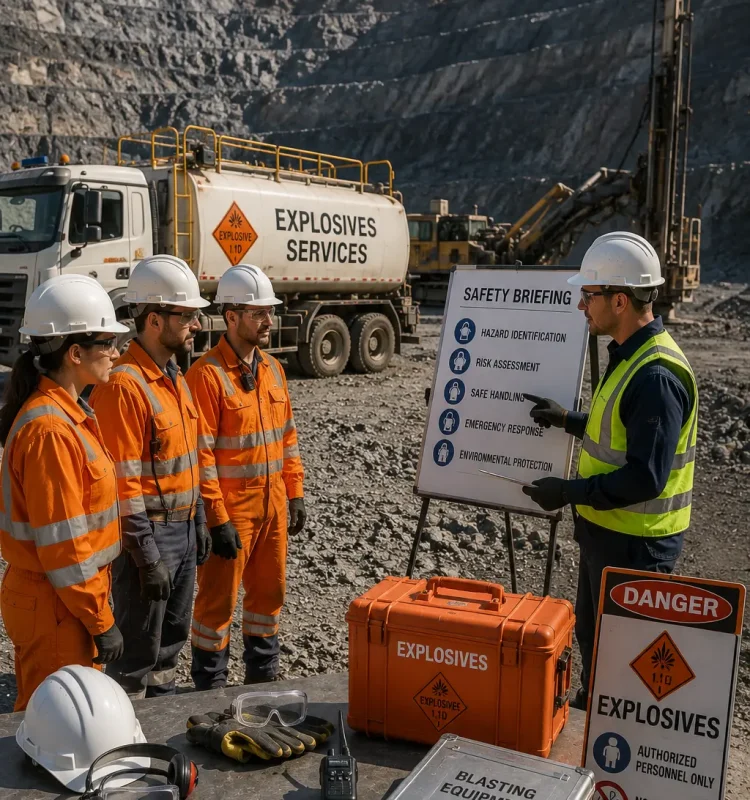
Where specialised mining safety consulting makes the difference
A mining operation can need safety support across many fronts. But when the work involves explosives, blasting and critical processes, there are areas where specialised mining safety consulting delivers a level of control that generalist WHS advice cannot match.
Safe work procedures
Reviews and improves the safety procedures applied to critical tasks, making sure the documented standard is genuinely met on site, not just on paper.
Explosives & blasting safety
Addresses storage, transport, handling and firing of explosives — the high-consequence activities where specialised mining safety consulting adds the most value.
WHS compliance
Reviews consistency with the WHS framework and state mining regulations, preparing the operation for audits and regulator inspections.
These areas are connected. A weak safe-work procedure can lead to an incident; a gap in explosives handling can be catastrophic; a compliance breach can halt the site. That is why mining safety consulting should be addressed as an integrated, specialised system.
Safety procedures for sites that use explosives
Safe work procedures are the backbone of prevention. On sites that store, transport and handle explosives, mining safety consulting demands clear procedures, licensed personnel and verifiable controls. A single weak link in these procedures can turn a routine task into a high-potential event — which is why explosives-aware safety advice is not optional.
Key elements of explosives-aware safety procedures
- Review of safe work procedures and SWMS for each critical task.
- Identification of gaps between internal standards and real on-site practice.
- Assessment of competencies for personnel exposed to critical risks.
- Controls for storage, transport, handling and use of explosives.
- Analysis of incidents, near-misses and improvement opportunities.
- Strengthening of the operation’s safety culture.
When safety procedures are reviewed by a consultant who understands explosives, mining safety consulting stops being reactive. Risk scenarios are anticipated, controls are documented, and the operation is prepared to respond to deviations before they become incidents.
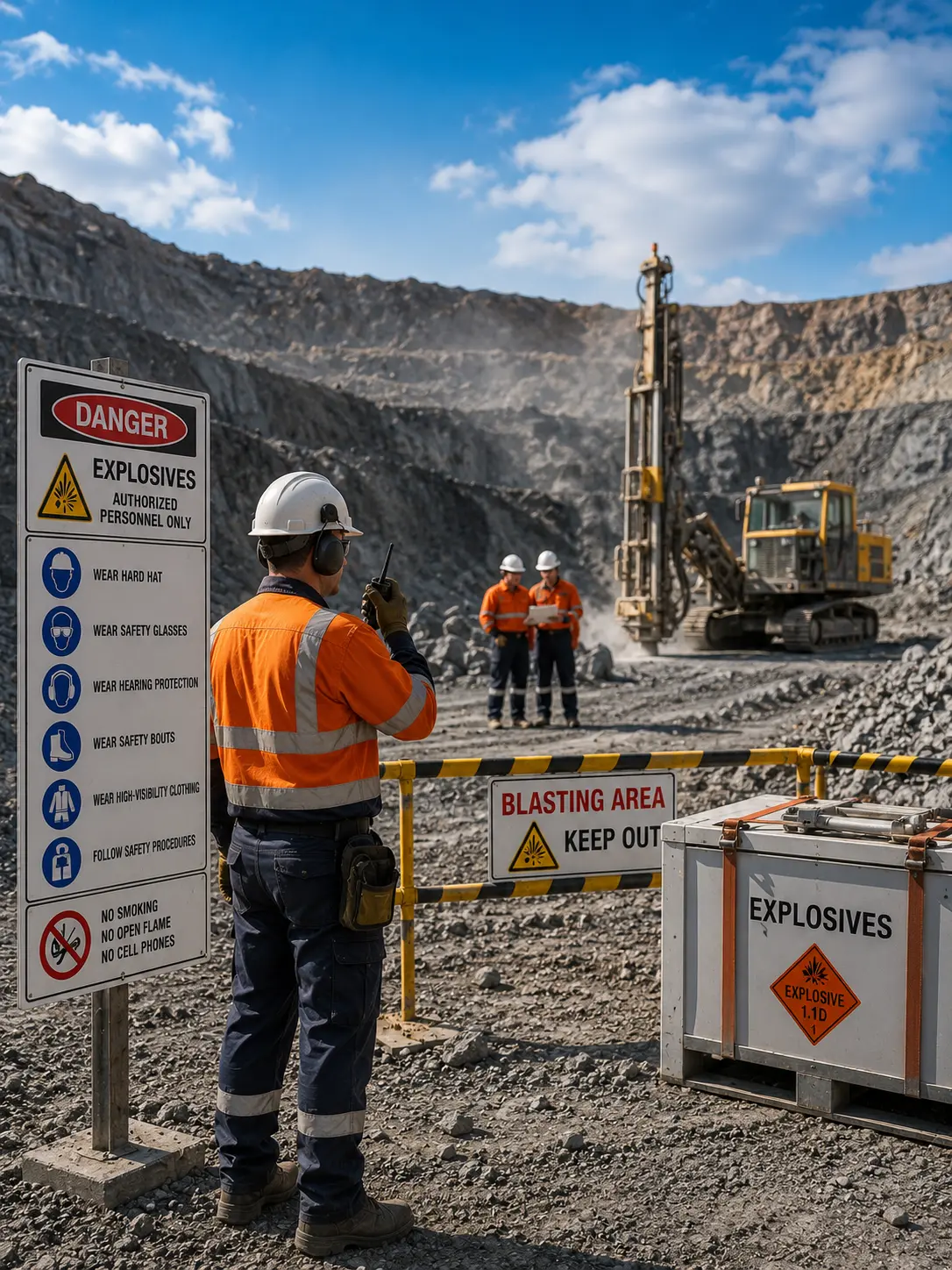
What mining safety consulting reviews on a high-risk site
Effective mining safety consulting combines controls over procedures, people and explosives. The table below summarises the key fronts our work covers, what is reviewed in each, and the expected outcome.
| Safety front | What is reviewed | Expected outcome |
|---|---|---|
| Preventive structure | WHS management system, roles, responsibilities and site safety governance. | Clear safety organisation and defined accountabilities. |
| Explosives handling | Transport, storage, handling and firing procedures by licensed personnel. | Lower likelihood of incidents in the most critical activities. |
| Occupational health | Exposure to dust, silica, noise and fumes, with health surveillance. | Prevention of occupational disease and traceable monitoring. |
| Emergency & compliance | Emergency plans, incident reporting and evidence for the regulator. | An operation ready to respond and ready for audits or inspections. |
Meeting WHS obligations is the baseline, but anticipating risk takes method. If the operation needs a structured approach to identifying and controlling threats, the mining risk management page works as a complementary vertical covering risk matrices, controls and prioritisation.
The WHS framework and why specialisation matters
Australia’s Work Health and Safety framework, built on the Model WHS Laws and adopted (with variations) across states and territories, places a clear duty on every Person Conducting a Business or Undertaking (PCBU) to eliminate or minimise risks so far as is reasonably practicable. For sites using explosives, this duty is demanding: the regulator expects evidence that critical controls exist and work. That is where mining safety consulting with real explosives expertise becomes decisive.
WHS consulting can build the management system and the documentation. But demonstrating that a blasting procedure is genuinely safe, that an explosives magazine is correctly controlled, or that a firing sequence manages energy correctly — that requires technical depth. STX Technologies brings that depth, complementing strong WHS foundations with specialised knowledge of explosives and blasting.
What specialised mining safety consulting reviews
- Consistency between the WHS framework and real on-site practice.
- Procedures and controls for explosives and blasting activities.
- Risk matrices and verifiable operational controls.
- Occupational health surveillance programmes.
- Training records and competencies of exposed personnel.
- Documentary evidence for regulator inspections.
The advantage of independent mining safety consulting is objectivity: it detects gaps the internal team can no longer see and documents compliance with technical depth. In an activity where a penalty can halt the site, that independence makes mining safety consulting an investment, not a cost.
Occupational health on mining sites
Mining safety consulting is not only about preventing accidents: it also protects workers from slow-onset occupational disease. Exposure to silica, dust, noise, fumes and vibration is one of the leading causes of long-term harm on mining sites, and its control is a core part of any complete safety approach.
Good occupational health management reviews exposure levels, applies engineering and administrative controls, and maintains health surveillance for exposed personnel. This demonstrates compliance and, above all, reduces cases of occupational disease that affect both people and operational continuity.
Health agents reviewed in mining safety consulting
- Exposure to silica and respirable dust at the working face.
- Noise from machinery and blasting operations.
- Fumes and air quality in underground mining.
- Vibration and ergonomic factors.
- Psychosocial risks linked to shifts and remote work.
- Health surveillance and traceability of exposure.
When to bring in specialised mining safety consulting
Bringing in external mining safety consulting is advisable when the operation faces decisions that need independence or specialisation the internal team doesn’t fully hold. Mining has high-consequence particulars — explosives, blasting, energetic materials — that demand expert insight to validate controls and prevent catastrophic events.
Signs your mining safety needs specialist support
- The operation has had high-potential incidents or recurring deviations.
- There are doubts about WHS compliance linked to explosives.
- A site needs assessing before starting a critical activity.
- Blasting, storage or handling procedures need updating.
- There is exposure to health agents without clear controls.
- Evidence must be prepared for a regulator inspection.
In these cases, consulting doesn’t replace the internal team: it complements it with method, analysis and actionable recommendations — backed by real explosives expertise — that strengthen the operation’s whole safety system.
Frequently asked questions about mining safety consulting
What does a mining safety consultant do?
A mining safety consultant helps an operation meet its Work Health and Safety obligations and control its hazards. This includes WHS audits, gap analyses, management systems, Safe Work Method Statements, training and incident investigation. STX Technologies adds a layer most consultants can’t: specialised expertise in explosives, blasting and energetic materials, where the highest-consequence risks sit.
How is STX different from a generalist WHS consultant?
Most WHS consultants cover many industries and treat mining as one of them. STX Technologies is built around explosives and blasting. We complement the strong WHS foundations a generalist provides — audits, ISO-style systems, documentation — with deep technical knowledge of how explosives behave, how blasts are designed, and how energetic materials must be stored and handled.
Does WHS compliance apply to all mining operations?
Yes. Under the Model WHS Laws, every PCBU has a duty to eliminate or minimise risks so far as is reasonably practicable, regardless of operation size. Smaller operations often carry greater exposure because they have fewer internal resources. Mining safety consulting proportional to the site’s scale lets it comply without excessive cost.
Why does explosives safety need specialist consulting?
Because explosives activities concentrate energy and risks that, if a procedure fails, can be fatal. Storage, transport, charging and firing must follow strict, verifiable procedures. A consultant without explosives expertise can review the paperwork but may miss the technical detail that prevents a catastrophic event. That technical detail is STX’s core.
Can you support both surface and underground operations?
Yes. The risk profile changes between surface and underground mining — underground adds confined atmospheres, ventilation and, in coal, flammable gases — but explosives hazards are present in both. Specialised mining safety consulting adapts the controls to the specific operation and method of extraction.
How does STX prepare a site for a regulator inspection?
STX reviews the consistency between what the company declares, what the regulation requires and what actually happens on site. We identify gaps in explosives procedures, safe-work documentation and controls, then organise the evidence. We hand it over as a client asset so the operation can sustain its safety case before any inspection.