
Emulsion technology: the complete technical guide for modern mining
Emulsion explosives combine colloidal chemistry, process engineering and operational design to deliver a unique balance of power, stability, safety and economic efficiency.
What are emulsions and why do they dominate modern mining?
Emulsions are dispersed systems formed by two immiscible phases that coexist in equilibrium thanks to the action of a specialised emulsifier. In the context of industrial explosives, a typical emulsion consists of an aqueous oxidising phase —rich in ammonium nitrate solution— dispersed as microscopic droplets within a continuous fuel phase of mineral oil. This architecture is the key to their performance: it maximises the intimate contact between oxidiser and fuel at the molecular level, allowing for an almost instantaneous energy transfer during detonation.
Unlike conventional explosives, emulsion explosives are intrinsically safe until the moment they are sensitised in the blast hole. This means that during transport, storage and handling they will not detonate in response to accidental stimuli such as impact, moderate heat or friction. This single feature has revolutionised the safety of the mining industry over the past few decades and is the main reason why emulsion technology has become the dominant solution in modern blasting.

Technical advantages that have made emulsions dominant in mining:
- Excellent water resistance, even in fully flooded blast holes.
- Adjustable density through chemical gasification or microspheres.
- Consistent velocity of detonation (VOD) between 4,500 and 6,000 m/s.
- Significantly lower production of post-detonation noxious gases.
- Prolonged chemical stability under demanding logistics conditions.
- Versatility to combine with ANFO to form hybrid products (Heavy ANFO).
Main applications of emulsion technology:
- Open-pit metal mining (copper, gold, iron, silver, lithium).
- Underground and mechanised mining.
- Aggregate quarries and industrial materials.
- Large-scale civil works (highways, tunnels, dams).
- Coal mining with specially formulated products.
For a deeper view of how this technology supports the broader Australian mining ecosystem, visit our Australian mining industry page.
Microscopic structure of emulsions: the science behind the performance
The microscopic structure of an emulsion is the determining factor of its detonating behaviour. A quality emulsion contains billions of oxidiser solution microdroplets with typical diameters between 1 and 10 micrometres, uniformly dispersed within the fuel matrix. This colloidal organisation is not accidental: it is the result of a carefully controlled high-shear emulsification process where every parameter — temperature, shear rate, residence time, emulsifier concentration — must be kept within precise tolerances.
Why does microscopic geometry matter so much? Because the velocity of detonation, the sensitivity to the initiator and the chemical stability all depend directly on the size, distribution and uniformity of the microdroplets. An emulsion with droplets that are too large loses sensitivity; an emulsion with heterogeneous droplets loses consistency between shots; an emulsion whose microscopic structure degrades over time loses its capacity to detonate predictably.
When the microscopic structure deteriorates —through droplet coalescence, crystallisation of the nitrate or rupture of the emulsifier film— the emulsion loses sensitivity and becomes unstable. That is why optical microscopy and advanced rheological techniques are applied to every batch produced in modern operations. To learn how chemistry and engineering converge to design these structures from the ground up, our experts can support your operation directly.
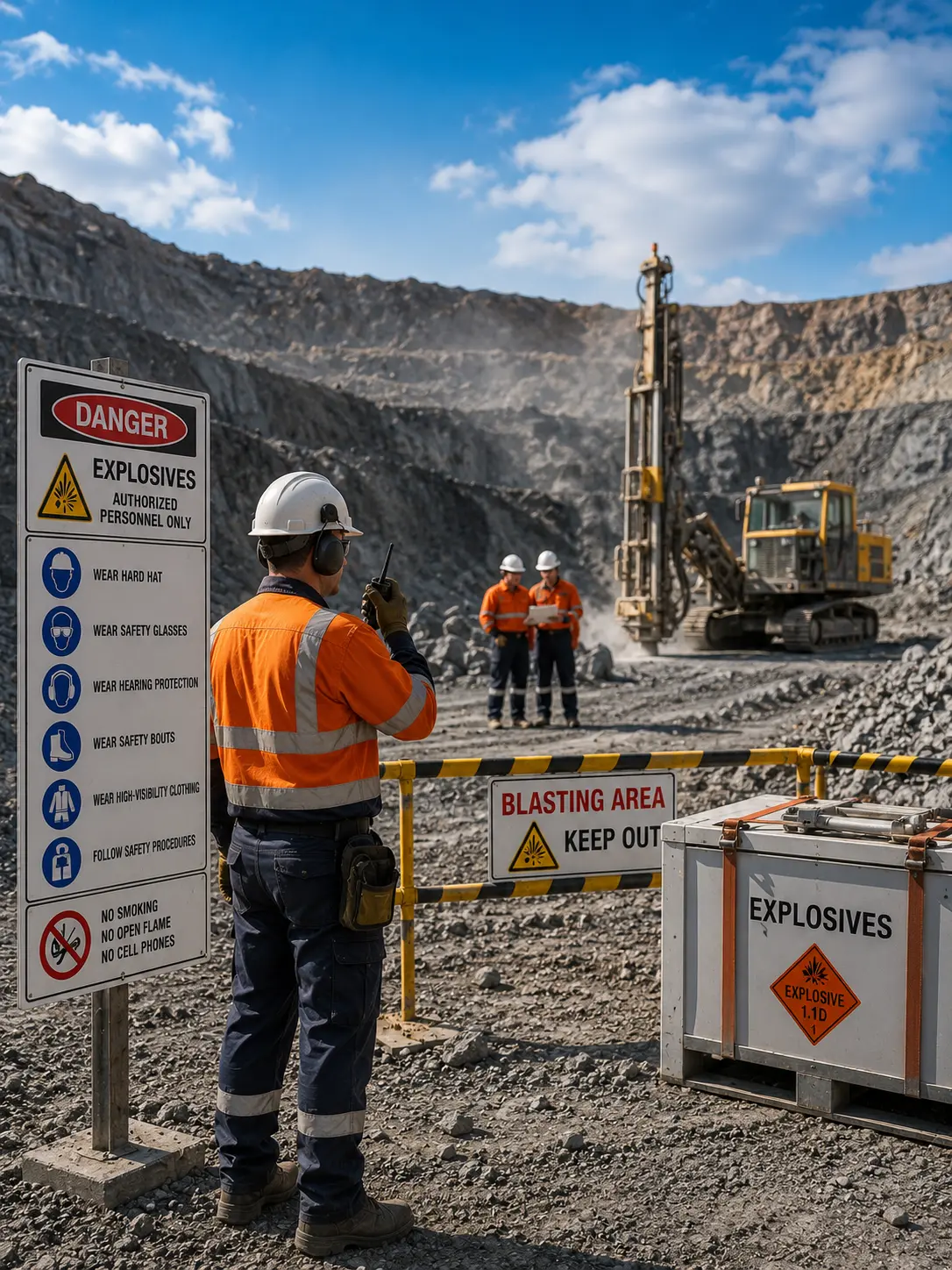
Emulsion explosives: the dominant family of modern mining explosives
Emulsion explosives are a family of industrial explosives based on the water-in-oil (W/O) emulsion architecture, where an aqueous oxidising solution of ammonium nitrate is dispersed within a continuous fuel phase. They are the most technologically advanced product line in the explosives industry and have progressively displaced traditional products in the vast majority of mining applications around the world.
Why operators choose emulsion explosives:
- High and adjustable energy delivered per kilogram of product.
- Outstanding water resistance compared with ANFO or watergels.
- Lower post-detonation fume generation than dynamite or some watergels.
- Greater operational safety due to intrinsic insensitivity of the matrix.
- Flexibility to formulate for specific rock, climate and barrel conditions.
- Compatibility with bulk loading systems (MMU trucks) and cartridged formats.
Main product formats within the emulsion family:
- Bulk emulsion matrix – Pumpable matrix sensitised at the blast hole by gasification.
- Cartridged emulsion – Pre-packaged in plastic cartridges for underground mining or small holes.
- Heavy ANFO – Blend of ANFO with emulsion (typically 10–50% emulsion).
- Boosters and primers – High-density initiating charges based on emulsion.
- Special formulations – Designed for reactive waters, high temperatures or extreme depths.
This combination of properties has consolidated emulsion explosives as the preferred choice in modern mining at a global level. To explore how the right blasting solution complements broader operations strategy, visit our mining consultancy page.

Mining explosives: how emulsions integrate into the productive cycle
Within the broader family of mining explosives, emulsions occupy the central position because of their versatility and safety profile. But emulsions are never used in isolation — they are part of an integrated system that includes initiators, boosters, accessories, drilling design and post-blast analysis. Understanding this integration is what separates a high-performance operation from one that merely uses explosives.
Typical mining explosives portfolio of a modern operation:
- Bulk emulsion matrix – For large open-pit blast holes.
- Heavy ANFO – For semi-wet conditions or cost-sensitive operations.
- Cartridged emulsion – For underground or small-diameter blast holes.
- ANFO – For dry blast holes and economic priority shots.
- Boosters – Cast or extruded charges to initiate the main column.
- Detonators – Electric, non-electric or electronic systems.
- Detonating cord and accessories – For transmission and delay sequencing.
How emulsion integrates into a modern mining cycle:
- In-situ production at a dedicated plant near the mining site.
- Controlled transport of the matrix to the MMU truck (Mobile Manufacturing Unit).
- Field sensitisation through chemical gasification at the moment of loading.
- Direct loading into pre-drilled blast holes following the blast design.
- Coordinated initiation with delays optimised for the blast plan.
- Post-blast analysis to optimise subsequent shots.
This integration is what allows world-class operations to extract real economic value from their explosives strategy. Reductions of 5–15% in total blasting cost are achievable when emulsion formulation, mining explosives selection, mesh design and sequencing are optimised together.
Fuel phase: the role of the continuous combustible matrix
The fuel phase of an emulsion explosive is the continuous oil matrix that encapsulates the millions of oxidiser microdroplets. It is much more than a passive carrier: it performs three critical functions simultaneously and its selection has a direct impact on emulsion stability, sensitivity, viscosity and overall performance.
Three core functions of the fuel phase in an emulsion:
- Encapsulation and protection of the oxidiser microdroplets against contact with environmental water.
- Energy contribution of the carbon and hydrogen needed for the combustion reaction.
- Rheology modulation of the product to enable pumping and loading.
Oils most commonly used as the fuel phase:
- Technical-grade mineral oil with low aromatic content.
- Refined paraffinic oils.
- Modified vegetable oils (for sustainable formulations).
- Specialised blends with antioxidant additives.
Critical properties of the fuel phase:
- Controlled kinematic viscosity to ensure good emulsification.
- Chemical purity, free of catalytic metals.
- Compatibility with the selected emulsifier (PIBSA, SMO, natural).
- Oxidative stability for extended storage periods.
- Adequate flash point for safe handling.
The balance between oxidiser solution, fuel phase and emulsifier defines the final performance of the product. A poorly chosen fuel phase can compromise an otherwise excellent formulation, while a well-selected fuel phase enables the formulation to reach its full potential over a long shelf life.
Emulsion system: the integrated view of formulation, plant and field
An emulsion system is the integrated set of formulation, equipment, processes, people and procedures that work together to produce, transport and use emulsion explosives reliably. Approaching emulsions only as a chemical formulation —ignoring the surrounding system— is one of the most common mistakes among operations that struggle to extract real value from this technology.
Core elements of a complete emulsion system:
- Chemical formulation – Composition, ratios, emulsifier and additives.
- Manufacturing plant – Reactors, tanks, dosing systems, automation.
- Quality laboratory – Microscopy, rheology, UV-Vis, pH, density.
- MMU truck fleet – Field sensitisation and loading capacity.
- Logistics chain – From raw materials to the blast hole.
- Operational procedures – SOPs, safety, calibration, traceability.
- Trained personnel – Operators, technicians, process and quality engineers.
- Documentation and traceability – Batch records, CoA, regulatory reporting.
Why the system view matters:
A weak link in any of these elements compromises the entire chain. The best formulation in the world produces poor results if the plant lacks tight temperature control, if the laboratory does not monitor nitrites, if the MMU trucks lose calibration, if logistics fails to maintain the cold chain or if personnel lack the training to detect early signs of degradation. Operations that excel in emulsion technology treat it as a system, not as a product.
Frequently asked questions about emulsion technology
What is emulsion technology in the context of mining explosives?
Emulsion technology in mining refers to the science and engineering of producing and using emulsion-based explosives, where an aqueous oxidising solution of ammonium nitrate is dispersed as microscopic droplets within a continuous oil fuel phase. This water-in-oil (W/O) architecture provides excellent water resistance, adjustable density, consistent velocity of detonation and high operational safety because the matrix is non-detonable until sensitised at the blast hole. It has become the dominant explosive technology in modern open-pit and underground mining worldwide because no other product family combines these properties simultaneously.
Why is the microscopic structure of an emulsion so important?
The microscopic structure defines the intimacy of contact between the oxidiser and the fuel, which determines the speed and efficiency of the detonation reaction. Smaller, more uniform droplets (typically 1–5 µm) maximise the interfacial contact area and enable almost instantaneous energy transfer, translating into higher velocity of detonation, better rock fragmentation and consistent performance between production batches. Microscopic monitoring through optical microscopy is therefore a non-negotiable part of quality control in every modern emulsion plant.
What is the difference between bulk emulsion explosives and cartridged emulsions?
Bulk emulsion explosives are unsensitised matrix products delivered in bulk and sensitised in the field at the moment of loading, typically through MMU trucks using chemical gasification. They are ideal for large open-pit operations with high volumes per shot. Cartridged emulsions are pre-packaged in plastic cartridges and pre-sensitised, designed for underground mining, small-diameter blast holes or applications where bulk loading is impractical. The choice depends on hole geometry, total volume, safety considerations and logistics.
How does the ammonium nitrate solution influence the final emulsion?
The ammonium nitrate solution is the oxidising heart of every emulsion explosive, and its quality directly defines stability, shelf life, sensitivity and performance of the final product. Critical specifications include concentration (80–85 wt%), pH (4.5–6.5), nitrite content (below 50 ppm), metallic impurities (below 5 ppm each for Fe, Cu and Cr) and stable handling temperature (80–95 °C). Deviations in any of these parameters compromise the chemistry of the emulsion in ways that may not be detected until weeks or months later, when the product fails in the field.
What role does the fuel phase play in emulsion explosives?
The fuel phase is the continuous oil matrix that encapsulates the oxidiser microdroplets. It performs three critical functions: it protects the microdroplets from contact with environmental water, it contributes the carbon and hydrogen needed for the combustion reaction, and it modulates the rheology of the product to enable pumping and loading. The selection of the right oil —mineral, paraffinic or modified vegetable— and the right additives directly impacts emulsion stability, sensitivity and overall performance.
Is emulsion technology a fixed standard or an evolving field?
Emulsion technology is one of the most actively evolving fields within explosives engineering. Current developments include biodegradable and renewable emulsifiers, nano-emulsions with droplet sizes below 1 µm, variable-density gasification for stratified blast hole loading, AI-driven stability prediction and chemistry tailored to reactive waters and extreme temperatures. The reference texts —such as the Encyclopedia of Emulsion Technology and academic compendia on emulsion science and technology— are regularly updated as new research advances. Operators who track these developments gain a strategic advantage in safety, sustainability and cost efficiency.