
Independent detonation testing and VOD measurement for mining explosives
Detonation testing is how you prove — objectively — that an explosive performs the way it should. Measuring the velocity of detonation (VOD), verifying chemical stability and confirming reliable initiation isn’t a technical luxury: it’s the difference between a dependable explosive and one that underperforms in the field. Every bulk explosive comes with a supplier-specified VOD range, but how often is it independently verified? At STX Technologies we run detonation testing in the laboratory and in the field, so your explosives meet their specification before they’re fired.
What detonation testing is
Detonation testing is the set of technical tests that characterise how an explosive behaves at the moment of detonation. Detonation is an extremely fast chemical reaction that releases enormous energy as a shock wave, and measuring its parameters tells you whether the explosive will behave as expected. Without these tests, a product’s real performance stays unknown until the shot is fired — by which point it’s too late to correct.
These tests cover both the physics and the chemistry of explosives. Detonation depends on the product’s composition, density, sensitivity and chemical stability over time. Detonation testing measures variables such as the velocity of detonation (VOD), detonation pressure and initiation reliability, delivering quantitative data you can actually make decisions on. For gassed emulsion-based explosives, VOD typically falls between 3,200 and 6,000 m/s — and verifying it sits within range is the point of the test.
For STX Technologies, detonation testing is at the heart of what we do. We combine laboratory testing with field verification, which means we don’t just measure an isolated parameter — we understand the explosive’s real behaviour under the conditions of the operation. Critically, we test independently: we don’t sell the VOD monitor and we’re not testing our own supply to confirm our own claims. That independence, plus our formulation expertise, is what makes our detonation testing trustworthy.
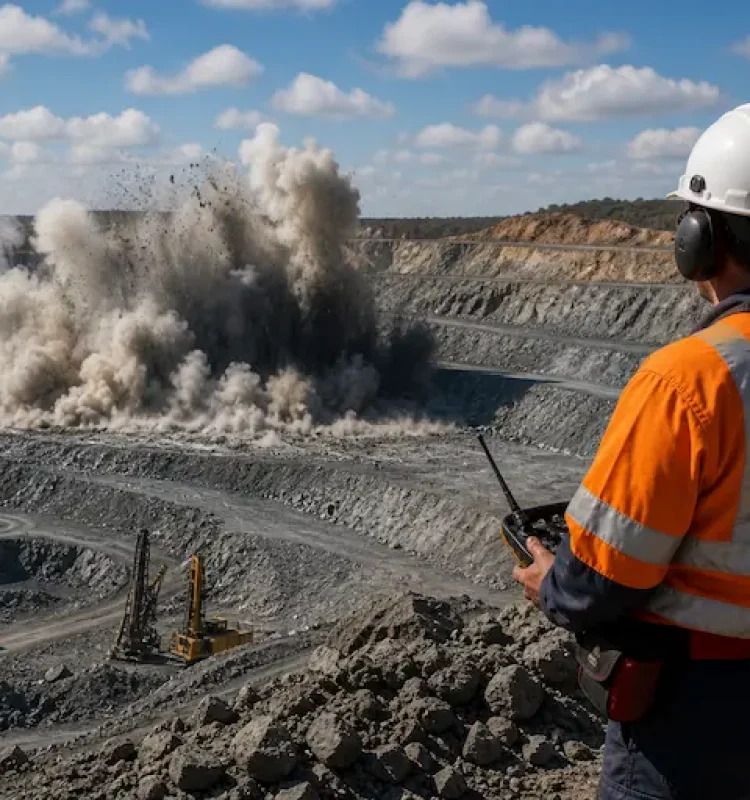
What detonation testing measures
Not all detonation testing measures the same thing. Each test reveals a different aspect of an explosive’s behaviour. These are the dimensions where technical characterisation delivers the most value for a mining operation.
Velocity of detonation
VOD is one of the most important parameters: it indicates how fast the detonation front propagates and how much energy the explosive releases into the rock — an industry-approved indicator of performance.
Chemical stability
Assesses how the explosive behaves over time. A product that loses chemical stability becomes unsafe and unreliable, and can fall outside its specification and compliance.
Initiation reliability
Confirms the explosive initiates safely and consistently, diagnosing why a detonator or charge can misfire in the field.
These dimensions are connected. A low VOD can signal a formulation problem; poor chemical stability compromises safety; unreliable initiation ruins a blast. That’s why detonation testing must be interpreted as a whole, with technical judgement — not as a single isolated number.
Velocity of detonation and the chemistry of explosives
The velocity of detonation is the magnitude that defines how the detonation wave travels through the explosive column. Together with density, it determines detonation pressure — the explosive’s capacity to fracture rock. Understanding the explosives chemistry behind this parameter is essential to selecting the right product for the material being blasted, and a higher VOD generally produces finer fragmentation.
Parameters that characterise a detonation
- Velocity of detonation (VOD): propagation speed of the reaction, in m/s.
- Detonation pressure: peak energy released behind the detonation front.
- Explosive density: a key factor in pressure and performance.
- Brisance or shattering power: capacity to fracture rather than displace.
- Sensitivity and initiation: ease and reliability of detonation.
- Chemical stability: behaviour of the explosive over time.
When these parameters are obtained through rigorous detonation testing, they stop being theory. They become actionable data that lets you choose the right explosive, tune its formulation and predict its real behaviour in the blast — instead of relying on assumptions or on the supplier’s own figures.
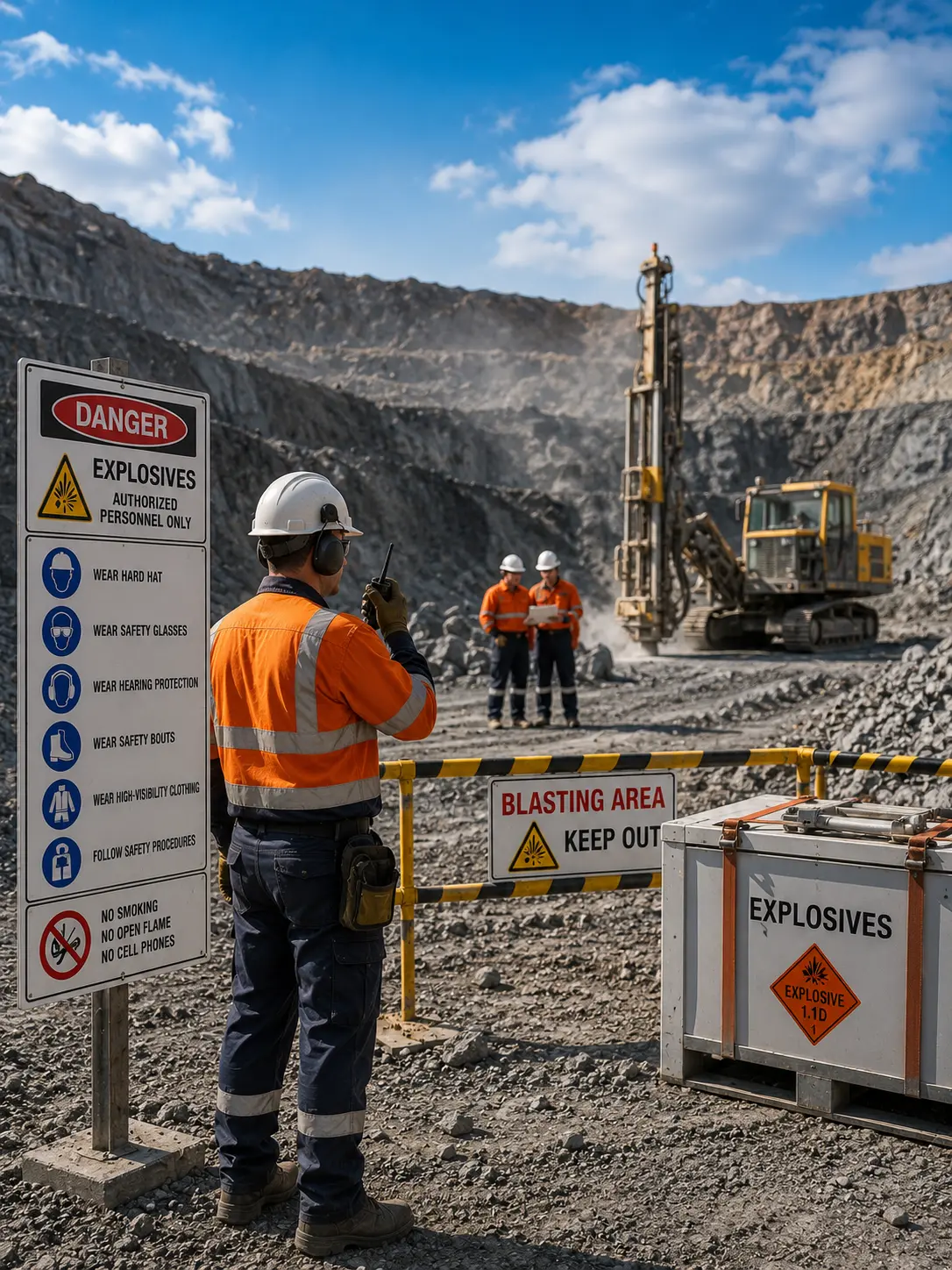
Key detonation tests and what they're for
There are different detonation tests, each aimed at characterising a property of the explosive. The table below summarises the most relevant in the mining industry, what they measure and why they matter for your operation.
| Test or parameter | What it measures | Why it matters |
|---|---|---|
| Velocity of detonation (VOD) | The speed at which the detonation wave propagates through the explosive. | Indicates energy performance and the quality of the formulation. |
| Detonation pressure | Energy released behind the detonation front — a function of density and VOD. | Determines the capacity to fracture hard or soft rock. |
| Chemical stability | How the explosive and its components evolve over time. | Ensures safety, shelf life and ongoing compliance. |
| Initiation test | The reliability and consistency of detonation initiation. | Helps diagnose detonator or charge misfires in the field. |
Detonation testing is directly tied to the formulation of the product. If your operation wants to understand how composition drives explosive behaviour, the emulsion formulation chemistry page goes deeper into the relationship between emulsion chemistry and detonation performance.
Why explosives fail — and how detonation testing diagnoses it
One of the most costly and dangerous problems in mining is an explosive that doesn’t detonate as expected: misfires, incomplete detonations, initiation failures. When this happens, the key question is why. Detonation testing is the tool that answers it with data instead of guesswork, diagnosing whether the root cause lies in the explosive’s chemistry, its stability or the initiation system.
This diagnosis requires real technical capability: a laboratory to analyse the product and field experience to reproduce the conditions of the operation. Measuring VOD, verifying chemical stability and testing initiation lets you isolate the cause of a failure and correct it before it recurs. It’s the difference between guessing and knowing — and it’s exactly the work STX’s core was built for.
What detonation testing helps resolve
- Diagnose why a detonator or charge didn’t function.
- Verify whether an explosive meets its nominal VOD.
- Detect loss of chemical stability in stored products.
- Validate new formulations before field use.
- Support compliance with technical evidence.
- Optimise explosive selection for the rock type.
The advantage of independent detonation testing is technical independence: STX doesn’t just formulate explosives — it tests, measures and diagnoses their failures, without selling the measurement equipment or marking its own homework. That capability to test and verify turns uncertainty into reliable data, and data into better decisions for your operation.
Detonation testing, quality and compliance
<p>Detonation testing doesn’t only improve performance: it’s also part of the evidence regulation expects. Explosives must be authorised, effective and chemically stable during storage. A product that isn’t tested is a product whose behaviour and safety can’t be guaranteed — a technical and a compliance risk at once.</p>
<p>That’s why, in the explosives industry, testing and compliance go hand in hand. Characterising the velocity of detonation, verifying chemical stability and documenting the tests generate the evidence regulators expect to see. Detonation testing is, in practice, the technical foundation of explosive quality control.</p>
<h3>What good explosive characterisation supports</h3>
<ul>
<li>Verification that the explosive meets its nominal parameters.</li>
<li>Control of chemical stability in stored products.</li>
<li>Technical traceability of the tests performed.</li>
<li>Validation of raw materials before formulation.</li>
<li>Evidence for audits and inspections.</li>
<li>Technical diagnosis of failures or deviations.</li>
</ul>
When you need detonation testing
Running detonation testing is advisable whenever the performance or reliability of an explosive is in doubt. The chemistry of explosives and their behaviour in detonation can’t be assumed — they have to be measured. A timely test prevents costly failures, poor blasts and safety risks in the field.
Signs you need a detonation test
- You’ve had misfires or incomplete detonations.
- You suspect an explosive isn’t reaching its nominal VOD.
- You have products stored long-term and doubt their stability.
- You’re validating a new formulation or a new supplier.
- You need technical evidence for compliance or audits.
- You want to optimise explosive selection for your rock type.
In these cases, detonation testing delivers certainty where there were assumptions. STX combines laboratory and field work to measure, diagnose and verify the real behaviour of your explosives — independently — turning detonation into a measurable, reliable process.
Frequently asked questions about detonation testing
What is velocity of detonation (VOD) and why does it matter?
Why did my blast fail or leave a misfire?
Detonation failures can originate in the explosive’s chemistry, a loss of stability, initiation problems or field conditions. The only way to know for certain is detonation testing that isolates the cause. STX combines laboratory analysis and field verification to diagnose why a detonator or charge didn’t function — independent diagnosis, not a supplier defending its own product.
Why use an independent tester instead of the supplier?
Most VOD verification is done by the explosive supplier testing its own product on-site — an inherent conflict of interest. An independent party with no stake in the supply gives you an unbiased measurement and diagnosis. STX doesn’t sell the explosive being tested or the measurement equipment, so the result reflects performance, not a sales position.
Do explosives lose properties over time?
Yes. An explosive’s chemical stability can degrade during storage, affecting its VOD and its safety. A deteriorated product is a technical and compliance risk. Detonation testing lets you verify whether a stored explosive still holds its properties or has lost reliability — particularly important for long-stored or aged stock.
Where is detonation testing carried out?
Both in the laboratory, to characterise the product under controlled conditions, and in the field, to verify its behaviour in the real conditions of the operation. STX integrates both: the lab delivers measurement precision and the field provides the real operational context, giving a far more complete diagnosis of the detonation.
How does detonation testing support compliance?
Regulation requires explosives to be authorised and chemically stable. Detonation testing generates the technical evidence behind that: it verifies the product meets its parameters, documents its stability and provides traceability for audits and inspections. It’s the technical foundation of quality control in the explosives industry — and it ties directly into our explosives compliance support.